
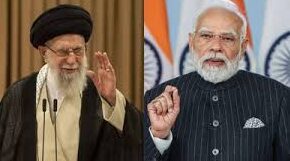
New Delhi: India has refrained from condemning the assassination of Iran’s Supreme Leader Ali Khamenei, while criticizing Iran’s attacks on Gulf countries and calling for restraint, dialogue, and de-escalation in West Asia.
Government’s response: Restraint, not support
The Ministry of External Affairs (MEA) has limited its public position to appealing for “restraint, dialogue, and de-escalation.”
Prime Minister Narendra Modi has spoken to the leaders of Gulf countries, including Saudi Arabia, the UAE, Bahrain, and Jordan. They have condemned the attacks on their territories and stressed the safety of the approximately 10 million Indians living in the region.
India has not condemned the US-Israeli attacks that reportedly killed Khamenei, nor has it offered condolences. Government sources indicate that the government’s response is driven by national interests, including energy security, diaspora welfare, and strategic partnerships in the Gulf.
History of Public Criticism
Khamenei has repeatedly commented on India’s internal affairs over the past ten years, prompting diplomatic protests from New Delhi.
In 2017, he appealed to the Muslim world to support the “oppressed Muslims of Kashmir.”
After the abrogation of Article 370 in August 2019, he urged India to adopt the “correct policy” on Kashmir in light of public opinion, prompting the Ministry of External Affairs (MEA) to summon the Iranian ambassador. During the debate on the Citizenship Amendment Act (CAA) in January 2020, Iran’s parliament speaker criticized the law, calling it “anti-Muslim discrimination,” a move India rejected as interference.
In March 2020, amid the Delhi riots, Khamenei tweeted that India must “confront radical Hindus,” described the violence as a “genocide of Muslims,” and warned of “isolation from the Islamic world,” using the hashtag #IndianMuslimsInDanger. The Ministry of External Affairs (MEA) again summoned the Iranian ambassador.
More recently, in September 2024, Khamenei placed India alongside Myanmar and Gaza in a social media post, prompting an official response from the Ministry of External Affairs, calling the comment “misinformed and unacceptable.”
Gulf Priorities and Strategic Coordination
India has strongly condemned Iranian attacks targeting Gulf countries, including Saudi Arabia and the UAE, which are major energy suppliers and host large Indian communities.
In separate conversations, PM Modi emphasized the importance of restoring peace in the region and thanked Gulf leaders for ensuring the well-being of Indians.
Foreign Minister S. Jaishankar also spoke with his counterparts from all six GCC countries following the escalation of hostilities, emphasizing India’s role in regional stability.
Over the past decade, India’s strategic engagement with Gulf countries has deepened, encompassing energy, defense, maritime security, and connectivity. This has been accompanied by a cautious approach towards Tehran.
Between 2005 and 2009, the Congress-led UPA government voted against Iran three times at the International Atomic Energy Agency (IAEA) during negotiations on the India-US civil nuclear agreement.
In 2022, the NDA government abstained from voting on a similar IAEA resolution related to Iran’s nuclear program.
The government has not directly responded to his comments. Officially, India maintains that it has consistently appealed for peace and stability in the Middle East.
With tensions rising across the region following the US-Israeli strikes and Iran’s retaliatory strikes, New Delhi’s public messaging has been restrained, condemning the attacks on its Gulf partners and reiterating its stance in favour of diplomacy.