
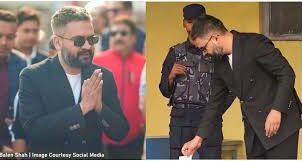
Former Kathmandu mayor, rapper-turned-politician, and engineer Balendra Shah has emerged as a major force in Nepal’s politics.
His Rashtriya Swatantra Party (RSP) is leading in several seats in early counting, putting the 35-year-old Shah at the forefront of the race to become the next prime minister.
Vote counting is currently underway in Nepal, which held its first general elections on Thursday after deadly GenZ protests forced former Prime Minister KP Sharma Oli to resign and dissolve Parliament.
The race also includes veterans like Oli’s Communist Party of Nepal (Unified Marxist-Leninist) and Pushpa Kamal Dahal’s CPN (Maoist Centre), parties critics say symbolize the loss of public support by an aging political force.
What could Balendra Shah’s victory mean for India?
35-year-old Balendra “Balen” Shah has established himself as the youngest political leader in the running for Nepal’s Prime Minister.
Shah, a former rapper-turned-politician, rose to fame after becoming Kathmandu’s first independent mayor. Shah, who holds a master’s degree from Visvesvaraya Technological University in Karnataka, has emerged as a youth icon in Nepali politics.
However, some of his past statements regarding India have drawn criticism. In 2023, he called for a ban on Indian films in Nepal, alleging that a Bollywood film portrayed the Hindu goddess Sita as “India’s daughter,” a claim he disputed, citing traditions that place her birthplace in present-day Nepal or near the Nepal-Bihar border.
That same year, he sparked controversy by displaying a map of “Greater Nepal” in his office—which included some Indian territories—which he described as a symbolic response to the “Akhand Bharat” mural in India’s new Parliament building.
Speaking on the issue, he told Dainik Bhaskar, “I never said anything for which I need to apologize. India called its parliamentary map a cultural map, so we put up a historical map of Greater Nepal. No one should have any objection.”
In 2025, he once again came under scrutiny for posting abusive language against India, the United States, and China. He later deleted the post after receiving criticism.
However, last month, he removed the China-linked Damak Industrial Park project from his election manifesto. The project, located in former Prime Minister Oli’s stronghold of Jhapa-5, is considered a key part of China’s Belt and Road Initiative (BRI). This move is being seen as a reassurance to India, especially regarding the security of the strategically sensitive Siliguri Corridor.
Furthermore, the RSP manifesto emphasizes the need for balanced foreign relations. As a relatively young and pragmatic leader – having studied in Karnataka, India – Shah is expected to prioritize economic cooperation, infrastructure development, and anti-corruption reforms, which could strengthen bilateral ties.
Although he has rejected some BRI-related initiatives and criticized the Nepali political elite’s closeness to Beijing, his inexperience in government may lead to unpredictable foreign policy decisions.
Overall, a government led by Shah could represent a disruptive, youth-driven shift away from Nepal’s traditional political system.