
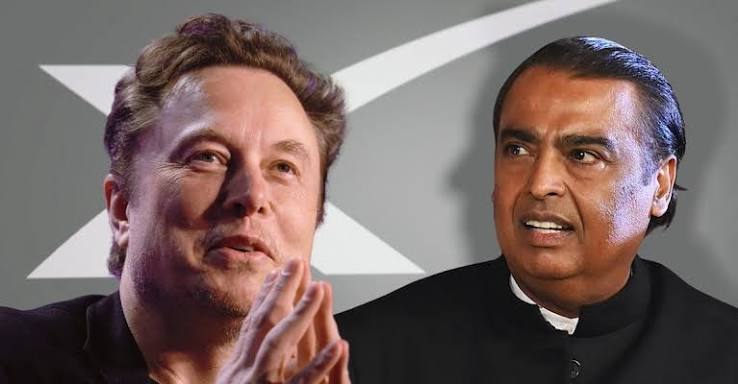
As Elon Musk intensified his criticism of the Indian government—alleging that billionaire Mukesh Ambani is blocking Starlink’s entry into the country—Reliance Industries hit back, stating that its own satellite internet service is also awaiting government approval.
In a sharp response, Reliance asserted that it welcomes competition and dismissed suggestions that it is attempting to prevent other companies from operating freely in India.
Musk, the world’s wealthiest individual, has repeatedly accused the Indian government and Ambani of obstructing Starlink’s long-standing efforts to enter the Indian market. The Indian government has denied any bias in its approval process.
Reliance’s statement on Friday—which did not explicitly name Musk—comes at a time when the company’s digital arm, ‘Jio Platforms’, is eyeing a valuation of $108 billion. This could potentially become the largest Initial Public Offering (IPO) in India to date.
Jio Platforms encompasses Reliance’s telecom business, which serves over 530 million subscribers and stands as a potential competitor to Starlink in the Indian internet market. “At Reliance, we have never shied away from competition,” the company stated, addressing “comments made regarding Reliance and the Indian market.” The company added that the purpose of this statement is to “place the facts before everyone.” The statement noted, “Jio itself entered India’s already crowded telecom market in 2016 as a new player, starting with zero customers. In just ten years, Jio has earned the trust of over 530 million subscribers and provided Indians with world-class digital infrastructure and the most affordable data.”
Think School
Two former ISRO scientists identified a flaw in SpaceX’s business model—and built a billion-dollar company based on that insight.
The statement further added, “We welcome competition in the satellite communication sector, including from Starlink. Every company—Jio included—should serve the people of India and comply with the country’s laws and policies.” Musk’s posts on X touched on various points—asking whether Ambani is the “real boss” of India, referring to him as “Prime Minister Ambani,” and questioning whether he would allow Starlink to compete in the country.
These attacks represent a significant shift in Musk’s stance, especially given his otherwise positive public rapport with Prime Minister Narendra Modi. This comes at a time when New Delhi is actively seeking foreign investment and negotiating trade agreements with Washington.
India has granted licenses to Starlink, Jio’s satellite internet division, and the Bharti-backed Eutelsat OneWeb to provide satellite communication services. However, none of them have yet received the necessary security clearances to begin operations.
Satellite broadband has the potential to connect millions of Indians who remain offline—particularly those living in rural and remote areas—to the internet.
Musk has stated that he intends to make Starlink affordable in India, enabling it to compete with Jio’s low-cost internet plans. Affordable data has been a key factor behind Jio’s rapid expansion in India. Musk has adopted a similar strategy to challenge established telecom companies in markets like Kenya.