
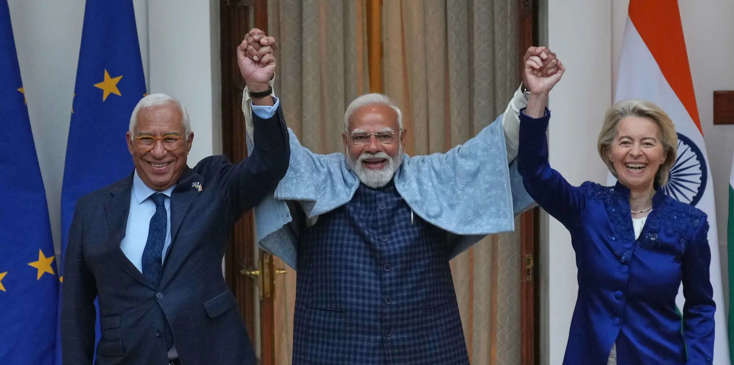
India and the European Union sealed a landmark free trade agreement (FTA) on Tuesday, marking the culmination of one of the longest-running trade negotiations between the two sides. European Commission President Ursula von der Leyen hailed it as the “mother of all deals,” as Prime Minister Narendra Modi hosted senior EU leaders for a high-level summit in New Delhi. The agreement is seen as a major step towards deeper economic integration, creating a vast free trade area covering nearly two billion people and strengthening strategic ties at a time of global geopolitical and trade uncertainties.
India, EU Seal Historic Agreement
Prime Minister Modi held extensive discussions with von der Leyen and European Council President Antonio Costa, with both sides emphasizing the importance of resilient supply chains, expanded market access, and long-term strategic cooperation. “Europe and India are making history today. We have finalized the mother of all deals. We have created a free trade area of two billion people, which will benefit both sides,” von der Leyen said, adding that the agreement is just the beginning of a strong strategic partnership.
Carmaker Cautious on Price Impact
However, despite the optimism surrounding the agreement, some companies remain cautious about the immediate impact of the FTA, particularly on vehicle prices. Mercedes-Benz India, for example, has indicated that it does not expect any price reductions in the near future. The company stated, “Over 90% of Mercedes-Benz India’s sales volume comprises ‘Made in India’ locally manufactured models, and only approximately 5% of sales are through CBU imports from the EU, therefore we do not anticipate any reduction in Mercedes-Benz vehicle prices from the FTA in the near future.” It further added that its focus will remain on local production and value creation through competitive pricing for Indian customers.
Tariffs, timelines, and immediate benefits are limited
Industry experts say that locally manufactured cars in India attract a basic customs duty of approximately 16.5%, while fully built imported vehicles from the European Union face duties of up to 110%. Furthermore, given the legal processes, multi-level approvals, and detailed implementation required, the FTA is not expected to come into effect until mid-2028.