
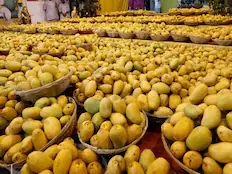
New Delhi: While Indian mangoes are currently making waves across the globe, Japan has halted the import of mangoes from India this season. This decision was taken after an inspection team identified certain irregularities in the country’s production facilities.
Since 2006, tons of mangoes—including varieties such as Kesar, Alphonso, Langra, and Banganapalli—have been exported to Japan every year; however, this year—after two decades—they have been banned. Prior to this, Japan had imposed a ban on Indian mangoes in 1986, citing a ‘fruit fly’ infestation as the reason. That ban was lifted 20 years later.
Every year, before the mango season begins, inspectors arrive from Japan. They oversee the ‘Vapor Heat Treatment’ (VHT) process—a non-chemical quarantine procedure in which mangoes are exposed to hot, humid air to render them pest-free.
This year as well, a team of quarantine officials from Japan conducted an inspection in Rahmanpur, Uttar Pradesh, during the month of March. During this visit, they identified certain deficiencies in India’s treatment facilities regarding ‘fumigation’ (pest eradication via smoke) and associated disinfection protocols. Consequently, Japan has imposed a ban on the import of mangoes.
A public interest organization in Japan—the ‘Yokohama Plant Protection Association’—which assists with quarantine protocols, has issued a notification stating that mango consignments accompanied by inspection certificates issued by India on or after March 25 of this year will no longer be accepted. The organization further stated that mangoes would be accepted only after improvements are made by rectifying the operational standards related to the treatment process. Akram Beg, an exporter from Uttar Pradesh, remarked, “A brand-new treatment system has been implemented to enhance the quality of Indian mangoes. If approval is granted exclusively to systems manufactured in Japan, it raises questions regarding monopolies and diplomatic maneuvering rather than mere technical compliance.”
Exporters have also alleged that Japan seeks to establish a monopoly in the fields of mango treatment and quality control.
Disgruntled Mango Exporters
Japan is a nation renowned for the quality of its products—be they mangoes or fish. Keeping Japan’s stringent regulations in mind, the Government of India established several VHT (Vapor Heat Treatment) plants within the country. This initiative commenced in 2007 with the VHT facility located in Tirupati.
India has consistently exported mangoes only after subjecting them to rigorous and meticulous treatment.
Although Japan may not rank among India’s most “significant” buyers, mango exporters remain deeply dissatisfied with this turn of events. In 2025, approximately 2.5 tons of mangoes were exported to Japan; while the Japanese market may not be vast in size, it holds immense strategic importance—particularly given that the domestic market is currently facing difficulties and exporters are incurring losses.
Top 5 Destinations for Mango Exports
Last year, mangoes worth approximately two million dollars were exported to Japan—specifically the ‘Kesar’ variety from Gujarat.
India’s top five export destinations for mangoes are the USA, UAE, UK, the Netherlands, and Saudi Arabia; meanwhile, Malaysia is also actively engaged in exploring opportunities within this sector.
The Government of India has not yet issued any public statement regarding this restriction. However, the Central Government is already engaged in discussions with the Japanese government.
Nevertheless, the mango season is now drawing to a close; consequently, there is very little likelihood that this ban will be lifted anytime soon.