
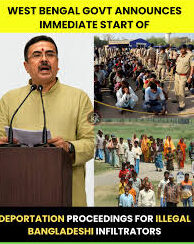
Comprehensive Action Against Infiltration
In West Bengal, a major crackdown on illegal Bangladeshi infiltration is currently underway, yielding tangible results on the ground. The process of identifying, verifying, and repatriating suspected Bangladeshi infiltrators has been accelerated; in just one week, the number of holding centers has risen to 11. Currently, more than 350 Bangladeshi nationals are being detained in these centers, primarily located in the Basirhat area of North 24 Parganas. Furthermore, the demolition of illegal structures constructed by infiltrators in border areas is also in progress.
National Security and Demographic Balance
This initiative is being regarded as a crucial step toward safeguarding national security and maintaining demographic balance. Surveillance and identification efforts have reached unprecedented levels, particularly in border districts such as Basirhat, Bongaon, Malda, Murshidabad, and Nadia. New centers recently established in areas like Tetulia, Charghat, and Medinipur are now housing hundreds of suspected infiltrators. Investigations have revealed that many infiltrators obtained identity documents—such as Aadhaar cards and Voter ID cards—by paying bribes. However, probes conducted by security agencies uncovered that these individuals also possessed identity documents issued by the Bangladeshi government, pointing to a long-standing, organized scheme involving illegal infiltration and document forgery. Security agencies are now meticulously tracing the entire network behind this operation.
Meanwhile, discussions regarding verification and repatriation are ongoing between the Border Security Force (BSF) and the Bangladeshi border security agency. Officials state that, following official confirmation of citizenship status, the infiltrators are being repatriated to Bangladesh in a phased manner. The message is clear: India’s borders are not an open door, and those who have entered illegally must return.
Revelations from Interrogations
Interrogations have yielded startling revelations. The arrested individuals admitted that agents exploited gaps in border patrolling to facilitate their entry into India, charging each person between ₹7,000 and ₹20,000. Subsequently, forged documents were fabricated, enabling them to settle in various regions and work as masons, laborers, or domestic help. This situation highlights not merely isolated instances of infiltration, but a well-organized and systematic operation—one against which strict action is now being taken.
The Government’s Stance on Infiltration
In a related matter, Union Home Minister Amit Shah stated in Ahmedabad that the situation in West Bengal has changed rapidly since the formation of the new government. He noted that while thousands of infiltrators previously entered the state daily, 5,000 to 10,000 infiltrators are now returning every day. He also announced that a Demographic Change Commission would be established to study shifts in the population structure and their underlying causes, as well as to consider necessary legal measures.
Discussion on Government Policy
This ongoing campaign has sparked considerable discussion regarding the policies of Chief Minister Suvendu Adhikari’s government. Swift action in border districts, the establishment of new holding centers, and improved coordination among security agencies demonstrate that the government is taking an uncompromising stance on illegal infiltration. A clear effort is evident to implement stringent measures to address this long-standing issue.
A Warning to Illegal Infiltrators
This serves as a stern warning to illegal Bangladeshi infiltrators currently residing in India. Forged documents, agent networks, and old methods of concealing identity will no longer be effective. The law is tightening its grip, and verification drives are being conducted at every level. For those residing illegally in India, the most prudent option is to respect the legal process and voluntarily return to their home countries.
The National Interest at Stake
Ultimately, the ongoing campaign in West Bengal is a matter concerning the national interest, the rule of law, and demographic balance. Indications suggest that these measures will intensify in the times to come.