
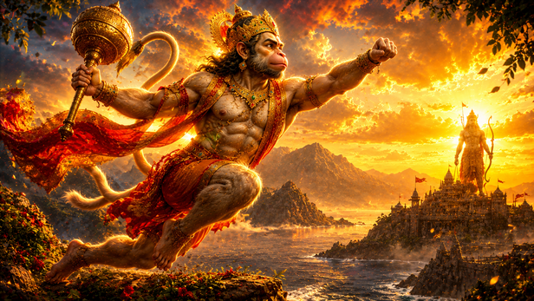
When we think of Lord Hanuman, we often recall his immense strength, fearless battles, and courageous feats. Yet, there is another facet to Hanuman—one that is equally inspiring, though less frequently discussed. Some of his greatest victories were achieved without ever lifting a weapon. Rather than relying on physical might, Hanuman utilized his intellect, patience, humility, and devotion to overcome challenges that appeared insurmountable. These pivotal moments from the Ramayana demonstrate that true strength does not always lie in winning a battle; sometimes, it lies in knowing when not to fight.
Hanuman Overcame Surasa’s Test Through Intellect
While crossing the ocean in search of Mother Sita, Hanuman encountered Surasa. She set a condition: Hanuman had to enter her mouth before he could proceed. Instead of attacking her, Hanuman perceived this as a divine test. He expanded his form to a massive size, compelling Surasa to open her mouth even wider. Then, in an instant, he shrank to a tiny size, passed through her mouth, and emerged on the other side—thereby respectfully fulfilling her condition and continuing his journey. This victory was secured not through violence, but through wisdom.
He Won Vibhishana’s Trust Through Humility
Upon entering Lanka, Hanuman met Vibhishana, the righteous brother of Ravana. Despite Vibhishana belonging to the opposing side, Hanuman harbored no prejudice against him; instead, he engaged with him through humility and sincerity. This honest interaction revealed that Vibhishana was deeply committed to ‘Dharma’ (righteousness) and wished to assist Lord Rama. This peaceful encounter marked the beginning of one of the most significant alliances in the Ramayana, demonstrating that trust and mutual understanding can often achieve far more than confrontation.
Hope became Hanuman’s greatest strength.
When Hanuman finally reached Ashoka Vatika, he found Mother Sita immersed in deep despair. He did not deliver grand speeches or engage in dramatic gestures; instead, he quietly placed Lord Rama’s ring before her—a sign that help was on the way. His gentle words rekindled Mother Sita’s faith and gave her the strength to remain patient. This teaches us that, at times, the path to resolving a problem begins not with force, but by offering hope to someone when they need it most. Hanuman did not allow anger to take hold of him.
When brought before Ravana, Hanuman had every reason to be enraged. Yet, he remained calm, conveying Lord Rama’s message with courage and clarity. His objective was not to seek revenge, but to establish peace by following the path of Dharma (righteousness). Hanuman’s self-restraint demonstrated that emotional discipline is far more significant than physical strength.
He prioritized his mission over personal glory
After locating Mother Sita, Hanuman could have remained in Lanka to challenge Ravana. However, he understood that his true responsibility was to return to Lord Rama with the vital information he had gathered. He placed his mission above his own personal identity, knowing that a lasting victory requires teamwork, careful planning, and patience. His discipline reminds us that true leaders focus on achieving the goal rather than proving their own individual heroism.
Every victory begins with devotion and discernment. What truly makes Hanuman extraordinary is not merely his immense strength, but his remarkable blend of courage and wisdom. He never allowed ego, anger, or arrogance to influence his decisions. His devotion to Lord Rama and his commitment to dharma (righteousness) were reflected in everything he did—whether it was resolving conflicts peacefully or demonstrating compassion in difficult circumstances. Hanuman proved that wisdom is the highest form of power.
Did Lord Hanuman always resolve problems through war?
No. Although Lord Hanuman was an exceptionally powerful warrior, there are many significant instances in the Ramayana where he addressed challenges through wisdom, humility, diplomacy, patience, and devotion, rather than through physical combat.
Why did Hanuman not fight Surasa?
Traditionally, the encounter with Surasa is viewed as a divine test of Hanuman’s intellect and discernment. Instead of resorting to a fight, Hanuman cleverly altered his size to fulfill Surasa’s condition, thereby allowing him to continue his mission peacefully.
How did Hanuman assist Mother Sita without using force? When Hanuman met Mother Sita in the Ashoka Vatika, he presented her with Lord Rama’s ring and conveyed his message, which brought her great comfort. His words rekindled hope within Mother Sita during a time of profound despair and further strengthened her faith.
What can we learn from Hanuman’s meeting with Vibhishana?
Hanuman’s respectful conduct toward Vibhishana teaches us the importance of maintaining an open mind and recognizing goodness, even in unexpected places. Trust and sincere dialogue can lead to the formation of strong alliances.